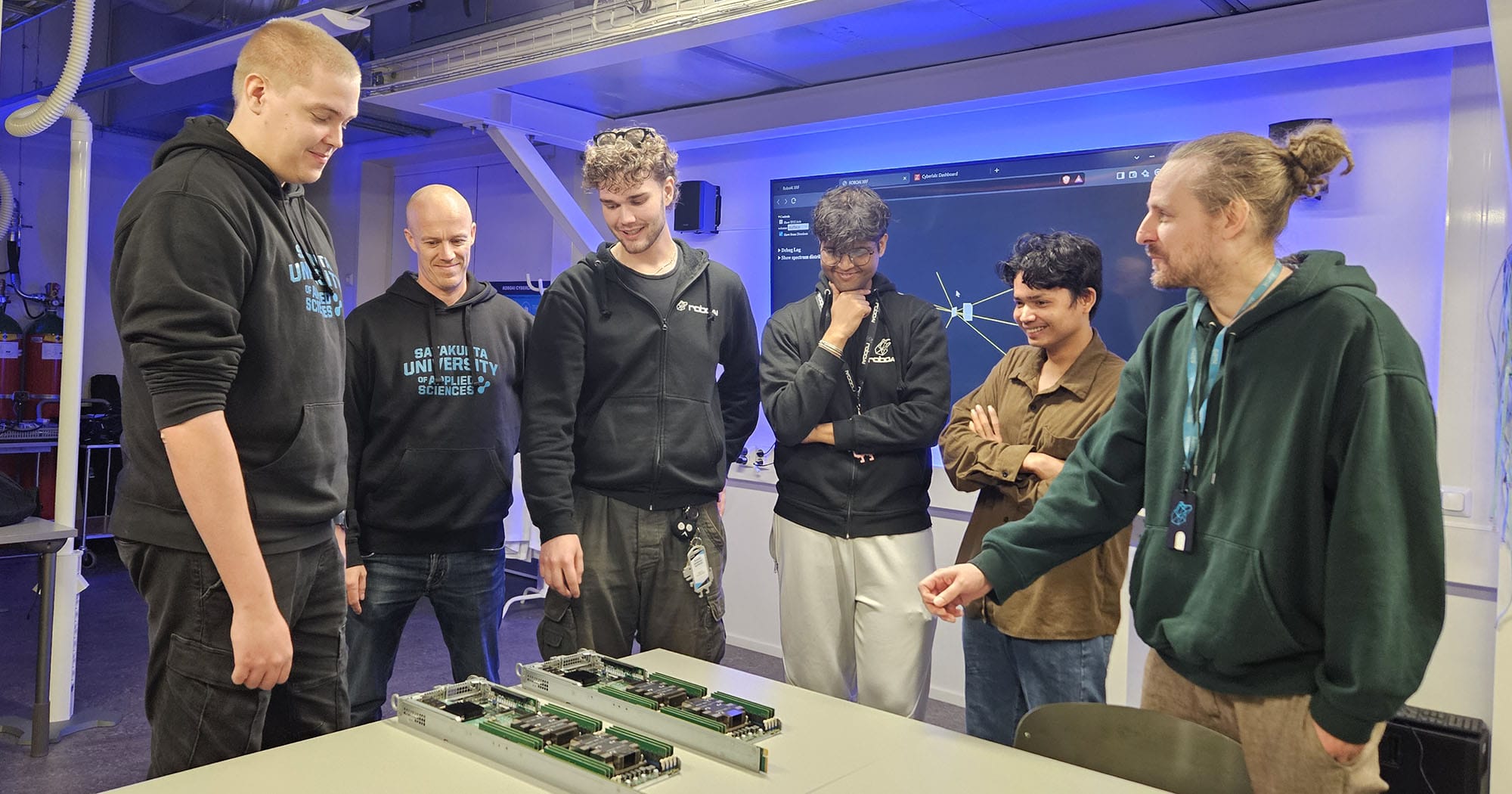
When SAMK received a donation of hardware from the supercomputer Puhti, operated by CSC – IT Center for Science, students took a leading role in getting the system up and running. Second-year Information and Communications Technology students Nuutti Pikkarainen and Atte Lindholm built a fully functioning system in approximately six weeks.
– At first, I thought there was no way I could do something like this. Now we have managed to put together an entire system. I have been surprised by how quickly I have learned, Lindholm says.
The work involved much more than simply assembling computers. The students installed servers, set up network connections and deployed software that enables computing tasks to be distributed across multiple machines.
Two toothbrushes and some cleaning solution
Along the way, there were also problems that were solved on the spot. On one occasion, an attempt to deploy ten computing nodes was cut short by a power outage. There has also been plenty of work to do with the hardware’s memory.
– We managed to salvage around 1.2 terabytes of RAM using two toothbrushes and some cleaning solution. It’s worth approximately EUR 9,700, Pikkarainen estimates.
According to Senior Lecturer Kimmo Viitala, the project has given students an opportunity to bring together individual technologies they have previously studied and combine them into a functioning whole.
– The operating environment includes networks, computers, hardware and software. Everything you need in a large-scale enterprise IT system, he explains.
Students are also making use of the computing power
While Pikkarainen and Lindholm have been building and maintaining the hardware, other students have been able to use its computing power for research. Twenty CPU computing nodes have already been brought into operation at SAMK Pori campus.
Akshat Gupta and Min Ngwe, students in the Data Engineering degree programme, are working on a project that uses artificial intelligence to develop a method for identifying the elemental composition of materials based on measurement results. The work requires a large number of simulations, which would take much longer to run on a standard computer.
The students have also developed a user interface for the research project. It allows users to adjust simulation settings and make use of the computing resources without having to acquire an in-depth understanding of the underlying software. The aim is to make the interface available to other researchers in the future as well.
– Originally, this was supposed to be a six-week project, but it has now been going on for seven months, and there is no end in sight yet, Gupta says with a laugh.
The research project originated from a discussion between Researching Senior Lecturer Toni Aaltonen and a Finnish company.
– This project brings together the core missions of a university of applied sciences: educating engineers who can solve real-world problems and conducting research that benefits the Finnish business sector, Aaltonen says.
New opportunities for study and research
SAMK aims to build a permanent high-performance computing environment that can be used in teaching, research projects and collaboration with businesses.
There are also plans to expand this environment. SAMK has received a donation of hardware from another decommissioned supercomputer, Mahti.
For students, the supercomputer offers an opportunity to develop skills needed, for example, in working with large-scale computing systems and data centres.
According to Lindholm, the project has also opened up new perspectives on his future career prospects. He originally came to SAMK specifically to study programming but has ended up working with large-scale computing systems.
Viitala particularly highlights the students’ motivation.
– This hasn’t been just another course assignment. The students have had a genuine interest in learning and making the whole system work. That is certainly one of the most important reasons behind the project’s success, he notes.