The most important thing is not whether a business is eventually established, but what students learn along the way.
Students can join the Enterprise Accelerator with an existing business idea, but having one is not a requirement. Each student chooses a mentor to explore their strengths and opportunities and discuss questions related to entrepreneurship.
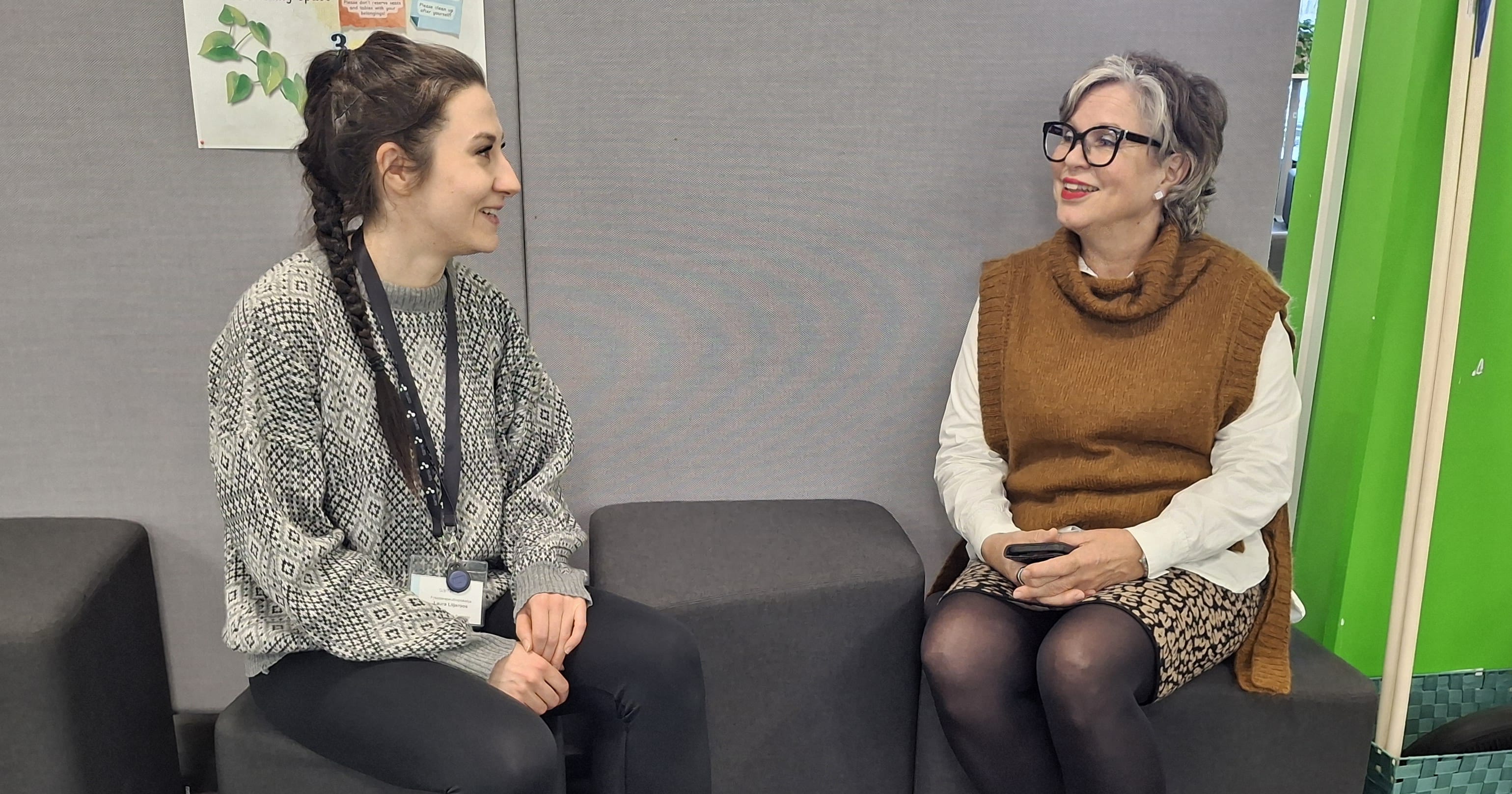
Pia Marjanen, Senior Lecturer and Enterprise Accelerator Mentor at SAMK, emphasizes that the aim is not to turn every student into an entrepreneur.
– The best outcome is that students discover skills and strengths they were not previously aware of, she says.
Mentors do not provide ready-made answers
Mentoring at the Enterprise Accelerator differs from traditional teaching. Rather than following a fixed timetable and completing set assignments, the activities are built around each student’s own goals.
Mentors do not provide ready-made solutions. Instead, they help students find the answers themselves.
– We mentors often ask more questions than we give answers, Marjanen says with a laugh.
Through their mentors’ networks, students can find the expert they need, a potential partner, or a connection to the business world.
At the same time, students develop skills valuable not only in entrepreneurship but also in working life more broadly: problem-solving, interpersonal communication, self-management, and the ability to operate in uncertain situations.
Learning by doing and experimenting
The Enterprise Accelerator draws on the principles of effectual entrepreneurship. The starting point is that you don’t need to plan everything in advance. Instead, you begin with your existing skills, available resources and networks.
Marjanen illustrates the approach with an example from cooking.
– In the traditional approach, you choose a recipe first and then buy all the ingredients you need. With the effectual approach, you look at what you already have in your cupboards and start creating something with those ingredients.
In entrepreneurship, this means conducting small experiments, learning from experience and adjusting plans when necessary.
– Sometimes things work out, and sometimes they don’t. But even when something fails, there is usually an opportunity to learn something.
Learning can also be very practical. At the Enterprise Accelerator, students can earn credits by developing their own businesses. Under certain conditions, they can also complete their practical training and thesis in their own businesses.
One example that has particularly stayed with Marjanen is student Tino Lehtonen, who developed an idea for an adventure park together with his brother. Lehtonen, who later went on to establish Seikkailupuisto Huikee, completed his practical training in his own company and subsequently based his thesis on his business idea.
– It was a concrete example of how developing your own business and pursuing higher education studies can support one another, she explains.
Entrepreneurship takes many forms
A wide variety of business ideas are developed at the Enterprise Accelerator. Participants include, for example, service-sector entrepreneurs and digital application developers. Entrepreneurship does not necessarily mean running a business full-time. It can start with a hobby, a small part-time venture or a desire to employ oneself through one’s own skills.
Marjanen has noticed that students are also becoming increasingly interested in networking. Some join the Enterprise Accelerator specifically to meet others who are interested in entrepreneurship and to develop something new together.
In the future, greater emphasis will be placed on supporting entrepreneurship among international students. They have been able to participate in the activities for some time, but in autumn 2027, the Enterprise Accelerator will introduce course implementations delivered in English. According to Marjanen, entrepreneurship can offer international students one possible route to employment in Finland.
The Enterprise Accelerator celebrates 30 years
SAMK Enterprise Accelerator celebrates its 30th anniversary this autumn. Over the decades, its activities have evolved, but one thing has remained unchanged: students have always been at the heart of the programme.
In the past, the Enterprise Accelerator also had its own physical premises. Today, its activities are built primarily around interactions between mentors and students. Mentoring has become increasingly diverse, allowing students to receive support from experts in several different fields.
Marjanen hopes that even more students will discover the opportunities offered by the Enterprise Accelerator in the future.
– We want to help students recognize their strengths and move forward. Not just in entrepreneurship, but in life, she concludes.