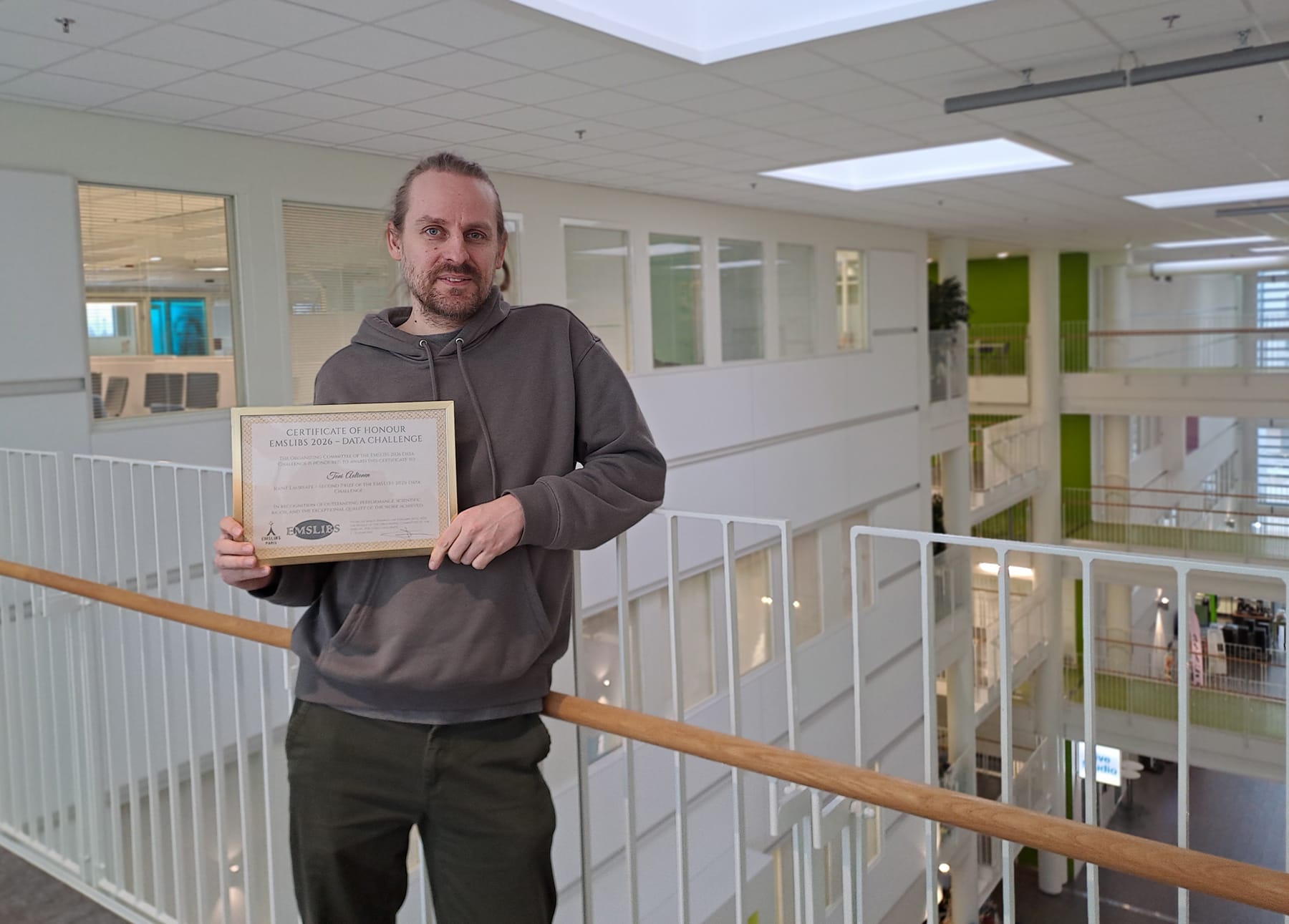
– At first, achieving a result felt impossible, which is exactly why I took on the challenge. It may also have helped that I was a bit bored during the Christmas holidays, Aaltonen laughs.
Participants in the competition were given a dataset of approximately 500 spectra divided into six different categories. The competitors were not told what substances the spectra represented; instead, by analyzing the dataset, they had to determine the composition of the original materials. After the competition, it was revealed that the dataset contained remains of six different individuals – specifically, bones.
New methods and a direct impact on teaching
A total of 18 research teams submitted results in the competition, many of which included multiple LIBS technology experts. The competition was won by an Algerian research team.
– I aimed to achieve the most stable answer possible; I wasn’t chasing perfection. I spent about 20 hours producing the final result, Aaltonen summarizes.
Toni Aaltonen has researched LIBS technology for several years. Through the competition, he once again developed several entirely new data-processing methods for utilizing LIBS on a global scale.
Aaltonen will bring this new knowledge directly into his teaching: the competition task will become a research case study in his Advanced AI Method course. In addition, an article will be written about the task for a leading publication in the field, and it will also become part of Aaltonen’s doctoral dissertation at Åbo Akademi University.
Neural networks could make LIBS more affordable
LIBS is already used relatively widely around the world, but one of its challenges is the high cost of technological implementation. Aaltonen is particularly interested in how neural network–based solutions could lower the cost of LIBS analysis and reduce the need for extremely high-quality data.
He believes that in the future LIBS could be utilized more extensively in archaeology, forensic and military research, as well as in elemental analysis within the food industry.
– LIBS also has many applications in space research, where research conditions are uncertain. The conference included developers of the LIBS instruments used in NASA’s Mars Rover, as well as experts from U.S. national laboratories, Aaltonen notes.
International interest strengthens SAMK’s position
Aaltonen’s LIBS expertise and strong performance in the competition sparked interest in international research collaboration with SAMK.
– We are already engaged in various forms of collaboration with international partners, but this was once again a step forward. Many people approached me at the conference, and we had in-depth discussions around the topic. Investing in LIBS research will be particularly important for SAMK in the future, he emphasizes.