The West Coast region from Turku to Kokkola is one of the engines of Finland’s economy and exports. Although the area is home to just under 17% of Finland’s population, it accounts for about 24% of the country’s industrial jobs. At the end of 2024, there were 80,300 companies in the region, representing 17% of all Finnish companies. In 2024, the West Coast generated approximately €19.7 billion in goods export revenues, which is over 27% of Finland’s total goods exports. The region is seeing strong investment, and by spring 2025, green transition investments either planned or underway amounted to about €75 billion, nearly a quarter of all investments in Finland.
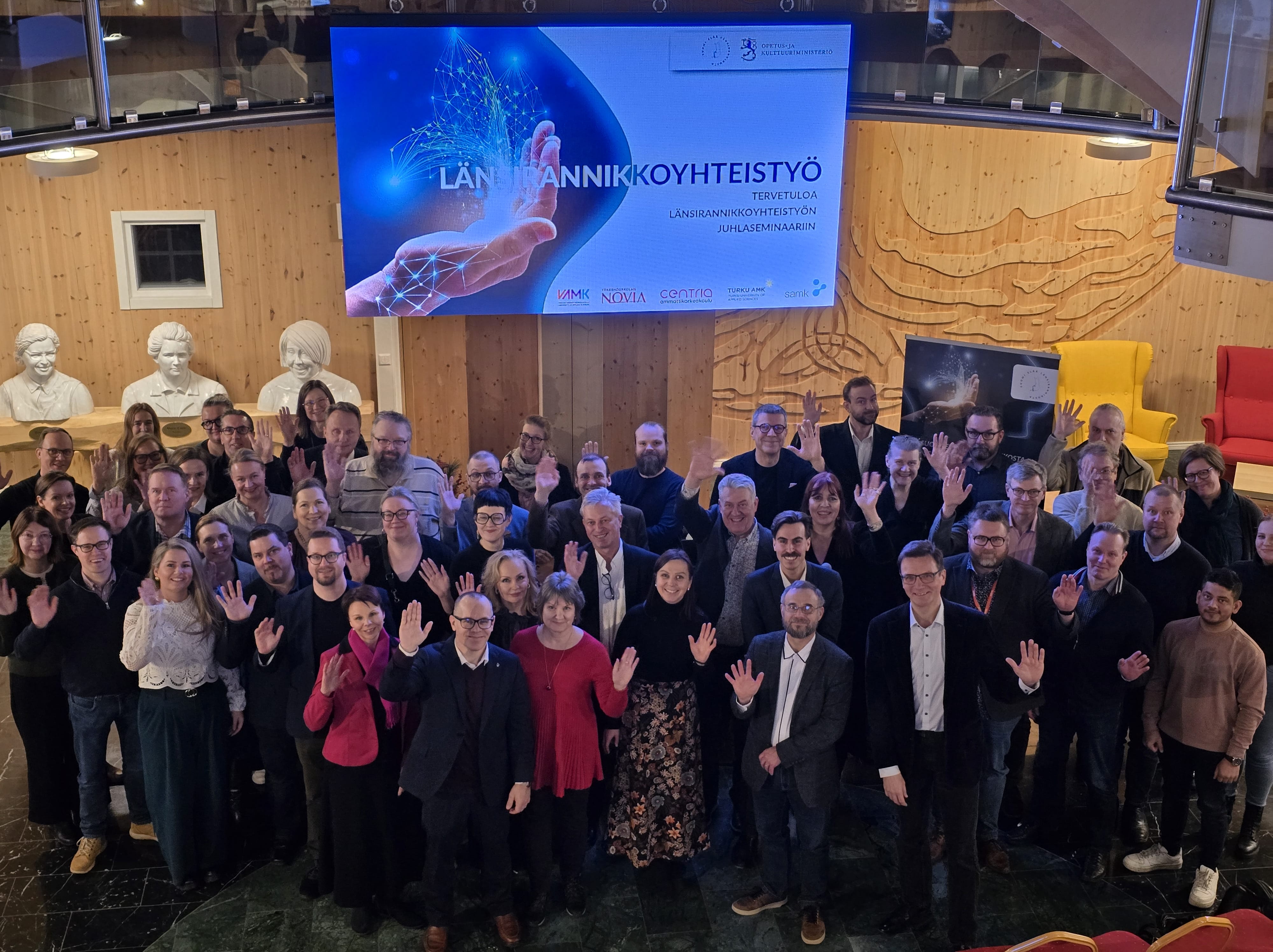
The West Coast is significant for Finland’s overall growth and competitiveness, and for three years the Ministry of Education and Culture has funded close and systematic cooperation among the universities of applied sciences on the West Coast. The collaboration, coordinated by Vaasa University of Applied Sciences (VAMK), has involved Turku University of Applied Sciences, Satakunta University of Applied Sciences (SAMK), Centria University of Applied Sciences, and the Swedish-language University of Applied Sciences Novia.
– Our collaboration is not just local. It is a strategic investment in the competitiveness, security of supply and green transition of the region and all of Finland. Together, we are building Finland’s growth, says RDI Director Marja-Riitta Vest from VAMK.
In the heart of investment, know-how and exports
The significant number of high-tech export companies in Southwest Finland, Satakunta, Ostrobothnia, and Central Ostrobothnia makes the West Coast a key player in national security of supply and provides a fertile ground for new innovations and production technologies. Alongside its vibrant business activity, the region’s higher education institutions host about 60,000 students, which accounted for 18% of Finland’s university students at the end of 2024.
The collaboration among West Coast universities of applied sciences during 2023–2025 has focused on supporting regional expertise in digital manufacturing technologies, automation and robotics, clean energy solutions, security of supply, as well as health and well-being. The long-term vision of this cooperation is multidisciplinary collaboration to address systemic challenges.
– The launch of the higher education collaboration was driven by the West Coast’s importance to Finland, measured by goods exports and value added in processing. In June 2025, the value of goods exports per capita from our four regions accounted for 41% of the total value across all regions. This is more than double compared to the regions’ share of the population. Our chosen slogan, ‘Finland thrives on the West Coast’, is even more true today than it was three years ago when we began close cooperation among higher education institutions. This successful collaboration provides excellent opportunities to continue our important work for the benefit of all Finland, states Vice President Cimmo Nurmi, from SAMK.
As part of the collaboration, closer partnerships have also been built with Sweden, for example, between regions such as Umeå and Vaasa. Also Finland–Sweden–Norway cooperation has been strengthened to address challenges related to the energy transition, skills needs, and changes in the security environment.
– Cooperation with Sweden is a strategic asset for the Kvarken region, the West Coast, and Finland more broadly. Cross-border collaboration between higher education institutions strengthens expertise, research, and innovation. Together, we can create an attractive work and study environment that benefits both countries, tells Otto Långvik, Research Coordinator, Novia.
Multidisciplinary collaboration together with companies
An advisory board composed of representatives from the region’s industries has been involved in developing and guiding the collaboration among West Coast universities. The role of the West Coast Industrial Advisory Board in the cooperation has been significant, particularly in promoting multidisciplinary collaboration and supporting the region’s smart specialisation.
– The West Coast is united by a positive structural transformation. Our challenges relate to securing skilled labour and the rapid adoption of technology in companies. Here, the extensive network of universities of applied sciences can work together to serve the needs of regional businesses more efficiently and effectively, tells Marko Forsell, RDI Vice President from Centria.
– West Coast collaboration plays a decisive role as we prepare for record-breaking investments in the green transition. Together, we ensure that our region’s companies can find skilled labour and grow to become internationally competitive. At the same time, cooperation between wellbeing services counties and higher education institutions generates radical innovations needed to secure care for an aging population. These are concrete examples of how our collaboration addresses the challenges of the future, states Juhani Soini, Vice President from Turku UAS.
– Four of the six fastest-growing institutions in terms of external research and development funding are universities of applied sciences on the West Coast. The collaboration has clearly advanced our goal of expanding RDI activities. Our cooperation with industry is particularly strong, says President, CEO Vesa Taatila from Turku UAS.
– This kind of collaboration is extremely important to us. Through these projects, we develop technologies to meet future needs and, at the same time, secure skilled workforce for the future, tells Kai Kamila, Lead HR Business Partner, Wärtsilä.
The collaboration will not end when the Ministry of Education and Culture’s funding concludes. The work has only just begun, and the cooperation will continue into the future.