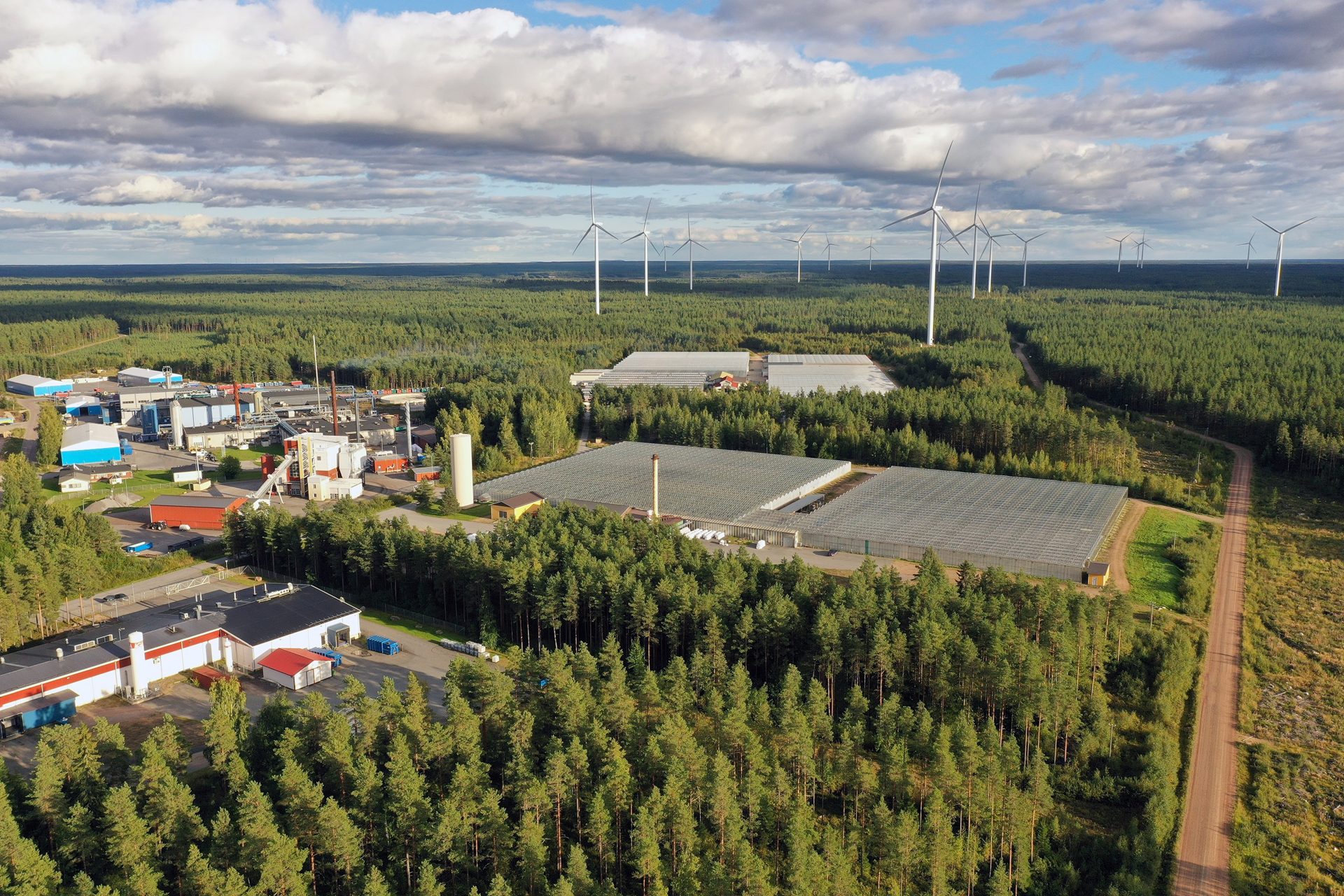
Kirkkokallio eco-innovation park is located in Honkajoki, Kankaanpää, in Northern Satakunta. There, everything is used resource-wisely. The by-products of companies’ production processes are used directly for the needs of other companies, so nothing goes to waste.
– It was Kirkkokallio’s circular economy and resource wisdom that sparked my interest, says Aro, describing the assignment. The first version of the logo, with its stylised wind turbines, did not quite capture the essence of Kirkkokallio among the group of companies operating there. After all, there is much more to Kirkkokallio’s circular economy than wind power. For example, waste can be turned into electricity or steam. Aro says that in the planning process, it is important to narrow down what the customer does not want. This way the visual artist can capture the essential in the design.
Aro runs her company Ridibundus, which offers services such as visual art, illustration, and graphic design. While ideas always come from a clean slate, the circular economy mindset is reflected in the artist’s work through the sensitivity to the possibilities of the material.
–The artist’s gaze can effortlessly find ways to utilise and highlight something that might otherwise have been thought to be useless, Aro explains.
SAMK-led project boosts R&D investments in Satakunta
The development of Kirkkokallio is one part of the SAMK-led project Northern Satakunta on the Waves of Green Transition, funded by the EU’s Just Transition Fund and the regional council of Satakunta. The project plays an important role in increasing research and development activities in the sub-regional area of Satakunta. Here, R&D investments have previously been only a fraction of the national average per capita, and even less in Northern Satakunta.
R&D activities of general interest are important for generating new knowledge, finding solutions, and developing regions. At its best, it contributes to the economic growth and competitiveness of the region. In addition, knowledge produced at regional level often benefits in a wider context and can be replicated elsewhere.
After the project, Northern Satakunta will have three strong clusters within circular economy, green transition, and technological solutions: Kirkkokallio eco-innovation park, construction product industry group, and GEO learning environment.